THE LIGHT COLORS OF OUR LED BULBS
WARM WHITE - HERE IS THE COMFORT IN THE FOREGROUND
Characteristics: Corresponds to the light of the bulb and creates a pleasantly warm and cozy atmosphere. Natural materials are particularly effective. Usually used in the living area for direct and indirect lighting eg in furniture. More room for maneuver is provided by LED bulbs, which are dimmable.
Areas of application: For example, like a ceiling light, ceiling light, wall light and recessed wall luminaire in the living area, sales and waiting areas in which a warm atmosphere is preferred.
Areas of application: For example, like a ceiling light, ceiling light, wall light and recessed wall luminaire in the living area, sales and waiting areas in which a warm atmosphere is preferred.
NEUTRAL WHITE - THE PLEASANT WORKING LIGHT
Characteristics: Located between warm and daylight white. Ideal for working without completely losing the feel-good character. It is pleasantly bright and inviting, already offers a good color rendering and increased contrast.
Areas of application: U. a. as recessed ceiling spotlight, ceiling light, wall light and recessed wall spotlights in kitchen, hallway, office, office, doctor's offices, graphic workplaces, as shop lighting and everywhere, where increased attention should be supported.
Areas of application: U. a. as recessed ceiling spotlight, ceiling light, wall light and recessed wall spotlights in kitchen, hallway, office, office, doctor's offices, graphic workplaces, as shop lighting and everywhere, where increased attention should be supported.
DAYLIGHT WHITE - THE FUNCTIONALITY IS CLEARLY IN THE FOREGROUND
Characteristics: Comes very close to natural daylight and is eye-catching and activating. It is very bright and rather objective and typically offers high color rendering and high contrast.
Applications: As a recessed ceiling light, ceiling light, wall light and recessed luminaire in the basement and garage, industry, laboratories, clothing, shoe, jewelry and flower shops, editorial offices and where brightness, highest attention, and concentration in the foreground.
Applications: As a recessed ceiling light, ceiling light, wall light and recessed luminaire in the basement and garage, industry, laboratories, clothing, shoe, jewelry and flower shops, editorial offices and where brightness, highest attention, and concentration in the foreground.
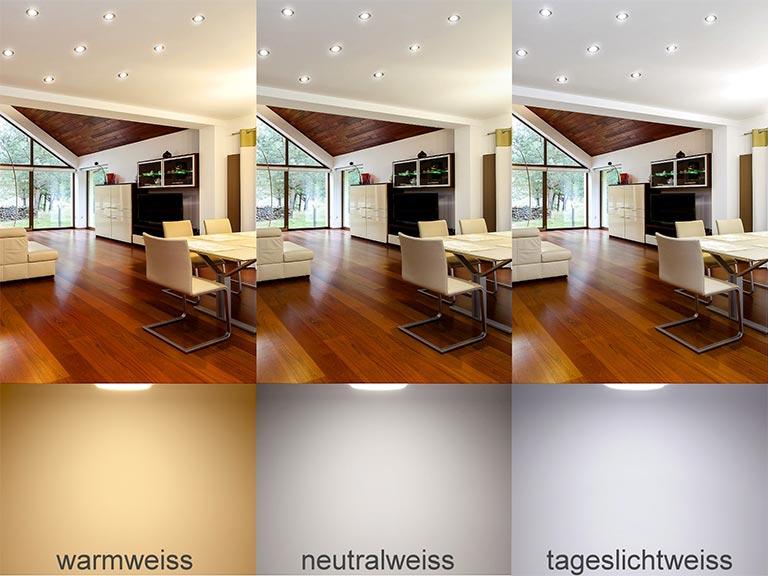
WHAT IS THE SO-CALLED LIGHT COLOR?
It characterizes the white sound of a light source and consists of color temperature and color rendering.
COLOR TEMPERATURE MEASURED IN KELVIN
eg warm white 2700-3000 K. The lower the value, the "warmer" the light, the higher the value the "colder".
Color rendering measured in (Ra). This is indicated on an index of 0-100 in. 100 corresponds to the highest possible color rendering, ie that of sunlight. The higher the value the better the color rendering. Light sources with a value of Ra 80 and higher are generally regarded as light sources with good color rendering. From Ra 90 we speak of very good color rendering. Indoors, the value should not be below Ra 80.
Color rendering measured in (Ra). This is indicated on an index of 0-100 in. 100 corresponds to the highest possible color rendering, ie that of sunlight. The higher the value the better the color rendering. Light sources with a value of Ra 80 and higher are generally regarded as light sources with good color rendering. From Ra 90 we speak of very good color rendering. Indoors, the value should not be below Ra 80.
THE DIFFERENCE BETWEEN COLOR TEMPERATURE AND COLOR REPRODUCTION
In simple terms, Kelvin describes the color of the light emitted by a light source.
By contrast, the color rendering index Ra describes how exactly colors are reproduced by a surface when they are "illuminated" with a specific light source. Light sources do not always reproduce the colors of the viewed surface correctly. For example, skin tones may appear pale under the light of certain lamps or vegetables unappetizing.
WHY IS LUMEN THE BENCHMARK FOR THE BRIGHTNESS OF A LIGHT SOURCE?
Lumen measured in (lm) is the unit of measurement of luminous flux. This means the emitted light quantity of an LED light source in all directions. The more lumens the lighter. At the time of the light bulb, it was relatively easy to deduce the brightness from the wattage. There was practically no separate indication of the lumen value because it always increased linearly with the wattage.
In the age of energy-efficient LED bulbs, this is no longer possible. Why? The LED technology is constantly evolving and every new generation of LEDs achieves more lumens from fewer watts.
In the age of energy-efficient LED bulbs, this is no longer possible. Why? The LED technology is constantly evolving and every new generation of LEDs achieves more lumens from fewer watts.
For this reason, the lumen is the measured variable with which illuminants with the same emission angle can be reliably compared in their brightness.


Skyled Engineering Pvt Ltd is The Best Alternate Energy Solutions
ReplyDeleteProvider in Pakistan. We are Sole and Exclusive Distributor of Honeywell LED Lighting in Pakistan.
Get a quote today LED Lights Pakistan
Thanks for sharing the informative post.
LED Lights Pakistan